A Civic & Economic Initiative
Bold enough to be seen. Simple enough to be remembered.
Your vote helps a volunteer committee bring a single unified proposal to South Dakota legislators for formal consideration.
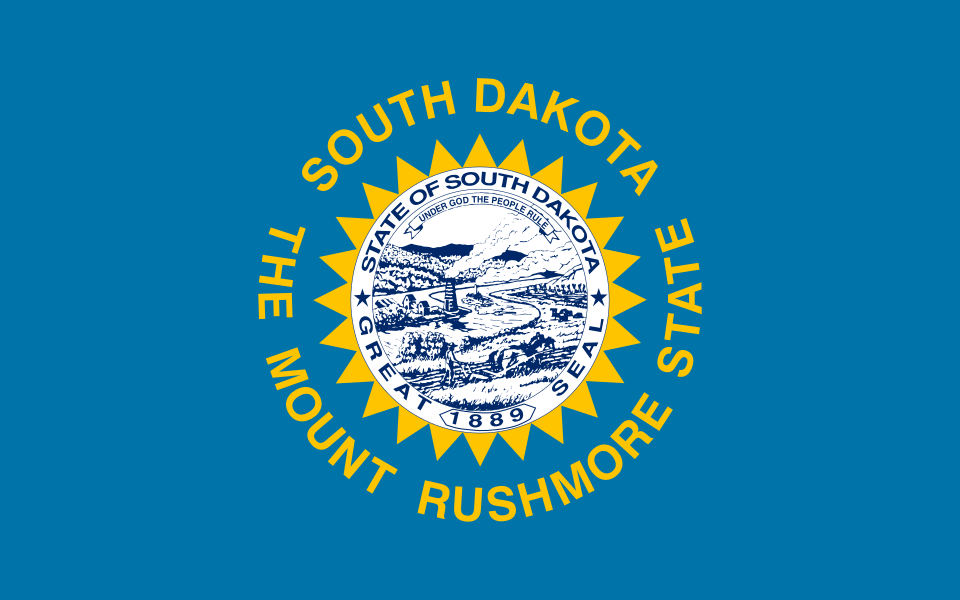
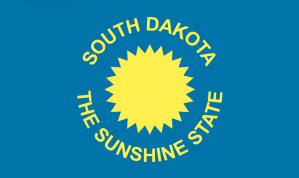
Past State Flags
The question is not whether a flag can evolve. It already has. The question is whether the next change finally makes the flag clearer, more memorable, and more useful as a symbol for South Dakota.
South Dakota's first official flag used a sun motif on one side and the state seal on the other. It already understood something important: a flag needs a bold symbol.
The wording changed to "The Mount Rushmore State," but the basic seal-on-blue approach remained. It still struggles at distance, on merchandise, and in small digital spaces.
The unofficial SoDak Governors history of South Dakota's flag walks through the 1909 original, the 1963 redesign, and the 1992 nickname update. The lesson is simple: we have changed it before. This time, we can do better.
Old vs. New
A state seal belongs on a document — up close, packed with historical detail. A flag belongs on a pole, a jersey, a storefront. It must be instantly readable from 100 feet away. Right now, South Dakota's flag fails that test completely.
The problem: South Dakota's 1992 flag crams the entire Great Seal — farmsteads, steamboats, miners, and legal text — onto a blue field nearly identical to dozens of other states. On a flagpole at 50 feet it is an unreadable smudge. The seal belongs on documents, not flags.
The opportunity: A narrative-driven redesign that still keeps the flag language clean: South Dakota blue, a unified Missouri River, a Sunshine State sun, West River heritage, East River agriculture, and symbols that tell the state's story without text or a seal.
Flags are not read — they are recognized in an instant. As distance increases, fine detail collapses into noise. A seal designed for close inspection becomes invisible on a flagpole. A bold symbol holds its identity at every scale.
At 200 feet, the current flag becomes an anonymous blue field. Rich's final design keeps its main read: blue field, gold state symbols, and a central river shape.
Design Progression
The design path starts with the basic flag question popularized by CGP Grey-style critiques: can it be recognized from far away? From there, the concept moves into a sun-and-Missouri-River identity, then into Rich's final wildlife-driven submission.
A cleaner flag-study direction influenced by modern flag-design principles: stronger symbols, fewer moving parts, and better distance readability.
The next simplified direction: a bold sun, Dakota blue, and a Missouri River form. This concept helped establish the color story and the distance-test logic.
The fuller narrative submission, bringing West River, East River, the Missouri River, agriculture, wildlife, Indigenous homage, and the Sunshine State identity into one design.
This design serves as a visually striking, deeply meaningful representation of South Dakota's rich heritage, diverse geography, and cultural identity. By combining clean vexillological geometry with symbolic regional elements, the artwork tells a complete story of the state from West River to East River.
Here is a breakdown of the artistic elements and symbolism woven into Rich's final submission.
The Buffalo: Standing strong on the left, the American bison represents the vast prairies, the history of the West River region, and the resilient spirit of South Dakota.
Native American Artistry: The shading and line work inside the buffalo are intricately detailed with traditional geometric patterns, spiral motifs, and an eagle/thunderbird silhouette. This pays deep, beautiful homage to the state's nine federally recognized tribes and the profound spiritual and historical connection between the indigenous peoples and the bison.
The Black Hills Spruce: Towering behind the buffalo is a majestic evergreen, specifically styled after the Black Hills Spruce, the official state tree. It anchors the left side of the flag in the rugged, forested geography of western South Dakota.
The Pheasant: On the right stands the ring-necked pheasant, the state bird, celebrated both as a proud symbol of South Dakota's world-class wildlife heritage and its vibrant outdoor traditions.
Soybean Shading: The delicate patterns inside the pheasant's feathers incorporate leafy, organic soybean forms, celebrating one of the state's most vital agricultural staples.
The Corn Stalk: Standing directly beside the pheasant is a crisp, detailed corn stalk complete with developed ears. This symbolizes the heart of South Dakota's agricultural engine, abundance, and the rich soil of the East River plains.
The Eastern Deciduous Tree: Behind the agricultural scene stands a full, leafy deciduous tree, reminiscent of the cottonwoods and bur oaks common to eastern river valleys, balancing the evergreen on the left.
The Winding River: Sweeping through the center is a winding blue river. Geographically, it represents the Missouri River, which physically cuts through the heart of South Dakota. Artistically, it serves as the ultimate unifier, connecting the distinct landscapes and stories of the East and West.
The South Dakota Sun: High in the sky sits a classic geometric sun with sharp, radiating rays. This nods to South Dakota's longtime identity as the Sunshine State, beaming warmth, growth, and optimism over the entire unified landscape.
The Color Palette: The backdrop uses authentic South Dakota blue, honoring the state's flag lineage. By restricting the rest of the artwork to golden yellow and lighter river-blue accents, the flag maintains a professional, modern, cohesive look that reads beautifully from a distance.
It is an intentional, narrative-driven redesign that balances simplicity with deep cultural and geographic substance.
Opinion Poll
This informal poll is meant to collect feedback before the proposal is shared more broadly. Vote for Rich's final design, one of the two other primary concepts, the current flag, or another direction from the broader concept set.
If you choose another direction, tell us what you would rather see. This feedback can be sent with the vote to the hosted campaign database once the online endpoint is connected.
✓ Thank you. Your feedback helps shape what gets recommended for South Dakota.
The Business Argument
The Great Seal stays — on legal documents and government filings where it belongs. A redesigned flag gives South Dakota a bold commercial identity that works for farmers, tourism operators, and manufacturers who want to put South Dakota on a label.
A clean flag becomes a brand mark for local agriculture and products — the way Texas and Maryland businesses leverage their flags as instant regional identity.
Tourism is our top economic driver. A recognizable symbol on merchandise and social media multiplies every marketing dollar spent attracting visitors.
A bold design prints cleanly on apparel, stickers, and products at any price point — a market the current complex seal simply cannot serve at scale.
A distinct identity helps South Dakota stand out to remote workers and professionals making location decisions — pride of place starts with a symbol.
No agency replaces patches or letterheads immediately. The new design phases in naturally as existing assets reach end-of-life — zero fiscal burden.
South Dakota's Great Seal remains on official documents and government correspondence — honored, intact, and in its proper context.
Open Design Challenge
Designers, artists, students, tribal members, and all South Dakotans — your concept could be presented to the volunteer committee and ultimately to state legislators. This is your flag too.
⚠️ After clicking, attach your artwork file before sending. Submissions without artwork cannot be reviewed by the committee.
A Personal Note
The real purpose of this initiative is public discussion: what is a flag, and what is a seal? A seal can be detailed, official, and ceremonial. A flag has a different job. It should be easily identifiable from a distance, use color to tell a story, and be simple enough that people can remember it, draw it, wear it, and rally around it.
The simpler, the better. Rich actually believes his final design may be too busy to be the final flag. It is submitted as ideation: a way to encourage a public debate about how South Dakota can tell its story through a single image on a flag.
The goal is to think forward: how can South Dakota be represented in a visible, motivating, and promotable way that works on a flagpole, a storefront, a jersey, a patch, a product label, or a tourism campaign?